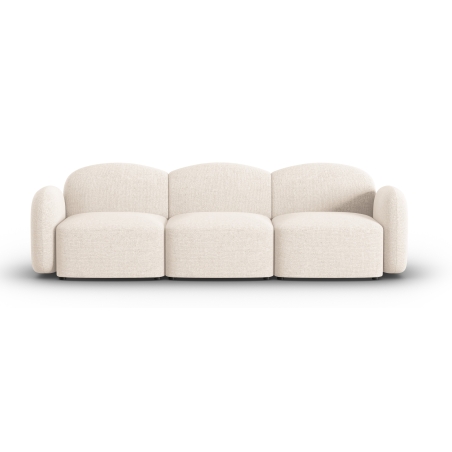
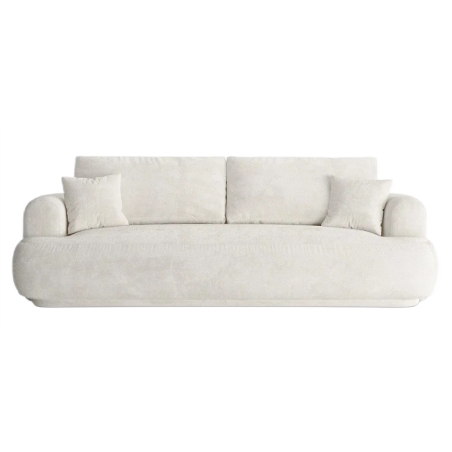
The wall behind the sofa is one of the most important places in the living room, yet an often overlooked element of the arrangement. Its potential is enormous - a well-planned space can change the character of the entire interior, attract the eye and create a coherent composition with a piece of leisure furniture. Before you decide what to hang or install on it, it is worth learning about specific solutions that work well in different layouts and areas.
A large wall behind the sofa: how to use the empty space for a distinctive visual effect
The wall behind the sofa is often left undeveloped, even though it is the ideal place to bring character to the living room. Instead of haphazard decorations, it is worth planning its finishing touches in advance. When choosing decorations, consider the width and height of the wall, the colour scheme of the furniture and how the sofa is positioned in relation to daylight. The space behind the sofa is a natural focal point for the eye - you can see it from the entrance and while sitting in the room, so a poorly chosen composition can disturb the perception of the whole interior.
One of the most common mistakes is to hang a single small painting, which "gets lost" in a large, empty space. Instead, it is better to opt for a larger form or a well-thought-out composition of several elements. The distance from the furniture is also important - the decoration should not start just above the backrest, but leave several centimetres of free space. It is good if the centre of the decoration falls more or less at eye level of the seated person. This gives a natural, pleasing arrangement to the eye.
It is also worth deciding whether the decoration is to play a dominant or background role. In the former case, elements with a strong colour, unusual form or texture can be chosen. In the latter case, subdued patterns or textures that do not distract from other elements in the room will work better.
Paintings, posters and wall galleries - how to compose graphics behind the sofa to avoid chaos
Graphics are one of the most common solutions used behind the sofa. However, rather than a haphazard set of frames, it's worth approaching the subject like a design - with a specific idea, colour and proportions. If you choose one large painting, it should occupy at least 60% of the width of the sofa and be hung so that the bottom edge is 20-30 cm above the backrest. The painting can be abstract, painterly, photographic or typographic - the key is that it should match the fabric and cushions on the sofa in colour.
Posters and framed prints are worth combining thematically - e.g. travel, botany, architecture - or stylistically, such as black and white photos in thin frames. To avoid clutter, it is best to stick to one frame format or use a symmetrical layout. A wall gallery looks good when it forms a rectangular area with clear edges - visual chaos has the opposite effect.
A good trick is to arrange the composition first on the floor before moving it to the wall. This helps to judge proportions and spacing without having to drill repeatedly. For rented flats, mounting tape and drill-free hooks work well. For added effect, you can add gentle LED backlighting behind the picture, which creates a pleasant atmosphere in the evening.
Textured wall: wood, laths, brick and wallpaper as a way of creating a strong backdrop
Instead of decorating the wall with accessories, you can turn it into a decoration in itself. Wood, vertical or horizontal laths, wallpaper with a distinctive pattern or brick are all materials that build up the atmosphere themselves. Laths are a great choice if you want to add depth and structure to a wall. They can be installed over the entire surface or just a section - for example in the shape of a vertical strip behind the centre of the sofa.
Brick, whether natural or decorative, introduces rawness and dynamism. You can paint it white or grey if you want to soften its character. Wallpaper with a strong pattern is the solution for those who do not want to mount anything on the wall. Leaf patterns, 3D graphics, stripes, large flowers or abstraction act as a scenic backdrop and no longer need additional decoration.
When choosing wallpaper, pay attention to its light resistance and ease of cleaning - especially for a wall exposed to hands or dust. In small rooms, designs with a light background will work better, in larger rooms you can afford darker, more contrasting motifs.
Shelves, panels and spatial arrangements - how to use the depth of the wall to display objects
Wall shelves behind the sofa not only give you the opportunity to display decorations, but also allow you to create variable compositions without interfering with the wall. One long shelf across the full width of the furniture, or two-three shorter ones arranged asymmetrically - either version can work, provided it is not overloaded with objects.
It is a good idea to place objects of different heights on the shelves, such as books, frames, candlesticks, figurines or ceramics. The key is to maintain balance - group objects into 'threes', mix textures and colours, but avoid excess. If the sofa stands in the centre of the room, the shelves above it should be clearly organised, as they are visible from all sides.
An alternative to shelves are ready-made wall panels with niches or recesses where spotlights can be installed. This solution allows you to create a setting that changes with the time of day. For those who prefer minimalism, a single niche or alcove with an embedded panel of natural material, such as stone or stabilised moss, is a good solution.
Lighting and unusual decorations - ways to create a surprise effect without overloading
Not every decorative element has to be a painting or a shelf. Increasingly, lighting points are being installed behind the sofa: wall lamps, LED strips or frame backlighting. Well-designed lighting allows you to build a mood and bring out the best in your decoration. Downlighting, directed at the fabric of the upholstery, can also have a practical function - for example when reading in the evening.
Textile decorations are also an interesting idea - large macramé, plaids, fabrics on the frame. These items introduce softness and texture and, if chosen properly, do not require frequent maintenance. It is worth opting for one larger object that is the main accent of the wall on its own.
LED neon signs with a quote, decorative hats, sets of ceramic plates or wood installations can all work, provided they are well thought out and linked to the style of the overall interior. The more unusual the decoration, the more attention it attracts - so it is better that it is unambiguous and centrally placed.
FAQ - Frequently asked questions
What size decoration should I choose so as not to overwhelm the sofa?
Ideally, the decoration should be between 60% and 80% of the width of the sofa. The height depends on the form - for paintings it is 40-60 cm, for galleries you can go higher.
Can shelves be mounted above a sofa bed?
Yes, but make sure you keep the right distance - at least 30 cm above the maximum height of the backrest when unfolded.
What kind of light will work best behind the sofa?
Warm, diffused LED light, mounted as a strip or spot sconces. Avoid cold light and spotlights aimed at the eyes.
Is a mirror behind the sofa a good idea?
Yes, if the wall opposite has an interesting view. A mirror visually enlarges the space, but it is worth protecting it from accidental bumps.

 Lounge furniture

 Chests of drawers, cabinets, display cabinets

 Tables, coffee tables and coffee tables

 Chairs and stools

 Wardrobes and shelves

 Beds and mattresses

 Office furniture

 Bathroom furniture

 Shelves and wall units

 Kitchen furniture

 Children's furniture

 Hallway furniture

 Consoles and dressing tables

 Extras