
 Lounge furniture

 Chests of drawers, cabinets, display cabinets

 Tables, coffee tables and coffee tables

 Chairs and stools

 Wardrobes and shelves

 Beds and mattresses

 Office furniture

 Bathroom furniture

 Shelves and wall units

 Extras
 Kitchen furniture

 Children's furniture

 Hallway furniture

 Consoles and dressing tables

 Extras



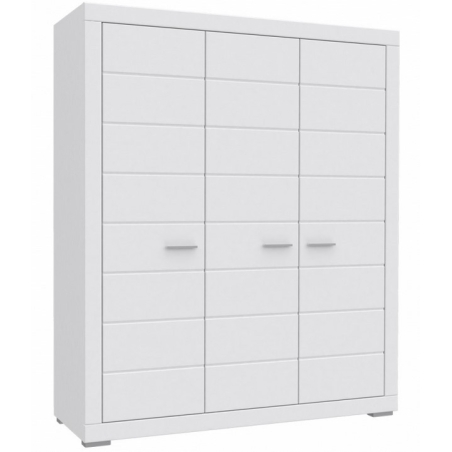
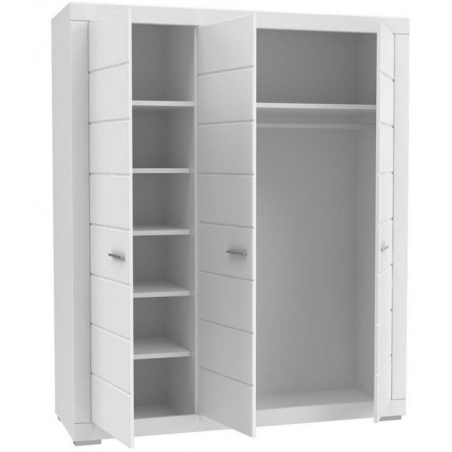
The hallway is the first and last place you see every day, and in Polish apartments it is often only 80–120 cm wide. That’s exactly why choosing between a sliding wardrobe and a hinged one is not a matter of style, but of math and walking comfort. In this guide, you’ll find specific numbers, a space calculator, and the answer to the question: which wardrobe won’t block your way to the bathroom at 7 a.m.
A wardrobe with hinged doors requires a so-called opening zone—free space where the door leaf swings. A standard door leaf is 40–60 cm wide, which means:
Hidden advantage of a hinged wardrobe: since it doesn’t need tracks, its корпус with a depth of 60 cm takes exactly 60 cm of floor space. Moreover, with the same external depth of 60 cm, a hinged wardrobe offers about 58 cm of internal space, while a sliding one only 50–53 cm—a noticeable difference when hanging coats.
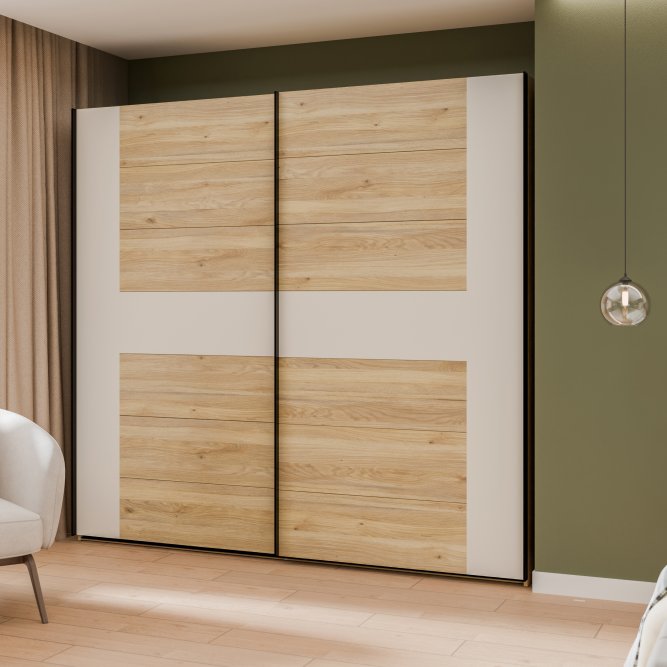
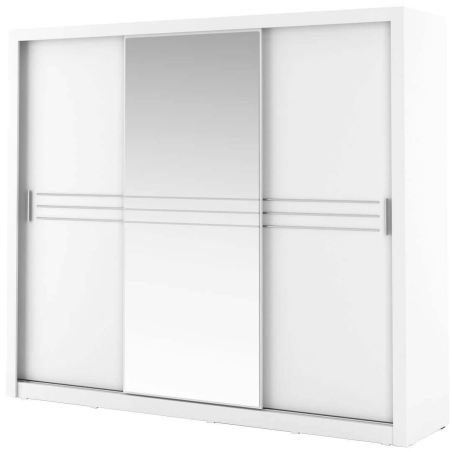
Sliding doors move parallel to the front—the opening zone is 0 cm. This is a game-changing difference in a narrow hallway. You can open a wardrobe in an 80 cm-wide hallway and easily reach your clothes without blocking the passage.
The cost of this convenience is depth: the sliding mechanism (tracks) takes about 8–10 cm, so a wardrobe with the same capacity as a hinged one needs a корпус depth of 65–70 cm. In very narrow hallways (below 90 cm), this may be too much.
Decision rule: if you have less than 120 cm in front of the wardrobe – choose a sliding system. Above 120 cm, you can safely consider hinged doors.
| Parameter | Hinged wardrobe (50 cm door) | Sliding wardrobe |
|---|---|---|
| Cabinet depth | 60 cm | 65–70 cm |
| Opening zone in front | 50–60 cm (required!) | 0 cm |
| Minimum hallway width | 120 cm | 80–90 cm |
| Internal space (at 60 cm external) | ~58 cm | ~50–53 cm |
| Access to interior | Full (all doors open) | Partial (always half closed) |
| Mirror on the front | Smaller, divided panels | Large single panel – better visual effect |
| Sensitivity to dust and sand | Low | Higher – tracks require regular cleaning |
Contrary to appearances, hinged wardrobes are experiencing a renaissance in 2026 in larger hallways. There are three reasons:
If you can’t decide – consider folding-sliding (accordion) doors. The panels fold in half, which means:
This is ideal for hallways 100–120 cm wide, where hinged doors are too wide and sliding ones seem too complex.
A minimum of 60 cm of free space in front of the furniture (door opening zone) plus room to stand. In practice, the hallway should be at least 120 cm wide for a hinged wardrobe to be comfortable for daily use.
Yes – that’s its biggest advantage. Sliding doors require no opening zone, so even in an 80–90 cm hallway you can use the wardrobe freely without blocking the passage.
This is the most common planning mistake. Before buying, check whether a fully opened wardrobe door collides with the bathroom door, room door, or light switch. If it does – the only safe solution is a sliding system or changing the door opening direction.
A hinged wardrobe. In sliding systems, sand and dust brought in on shoes settle in the bottom tracks, leading to noisy operation and faster wear of the rollers. The tracks require regular vacuuming.
Yes, and it does so more effectively than a hinged one. Large, uniform mirror panels on sliding doors create a stronger effect of visually doubling the width than divided mirrors on hinged doors.
| Situation | Recommendation |
|---|---|
| Hallway below 100 cm | Sliding only |
| Hallway 100–120 cm | Sliding or accordion |
| Hallway above 120 cm | Hinged or sliding (free choice) |
| Room door close to wardrobe | Sliding only |
| Priority: internal capacity | Hinged (approx. 8 cm more space) |
| Priority: mirror effect and optics | Sliding |
Functionality is the new definition of luxury in 2026—especially in small apartments where every centimeter has a price. Measure your hallway, apply this table, and the decision will become obvious.
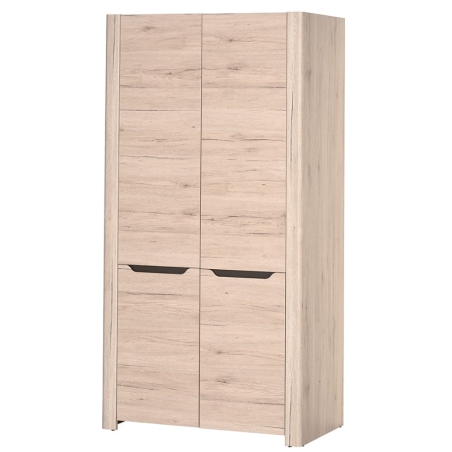

Wid: 98.00, Dep: 58.00, Hgt: 193.00.
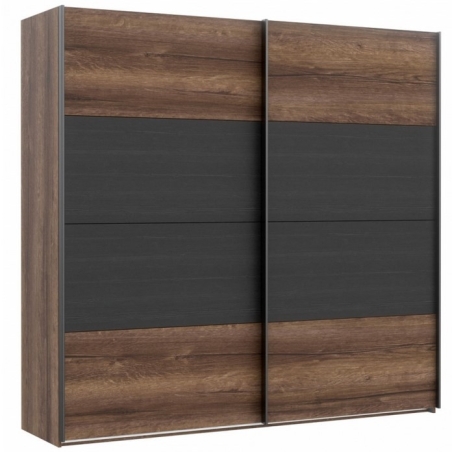

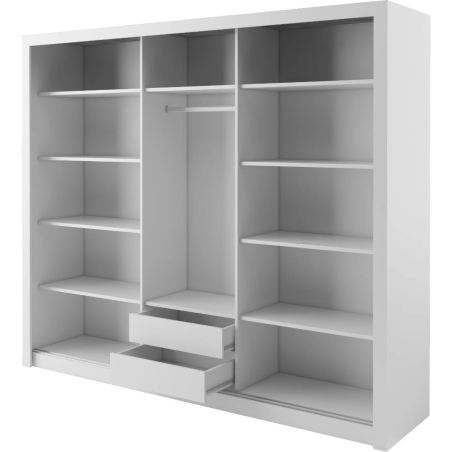
Wid: 200.00, Dep: 61.00, Hgt: 210.00.
Wid: 97.00, Dep: 41.00, Hgt: 97.00.
check_circle
check_circle