Lounge furniture

 Chests of drawers, cabinets, display cabinets

 Tables, coffee tables and coffee tables

 Chairs and stools

 Wardrobes and shelves

 Beds and mattresses

 Office furniture

 Bathroom furniture

 Shelves and wall units

 Kitchen furniture

 Children's furniture

 Hallway furniture

 Consoles and dressing tables

 Extras


A chest of drawers is one of the most functional pieces of furniture in our homes, but due to its construction and moving parts, it can pose a real danger. Pulled-out, loaded drawers drastically shift the furniture’s center of gravity, which—combined with children’s curiosity (e.g., trying to climb the drawers like a ladder)—can lead to tragedy. In 2026, awareness of furniture safety is higher than ever, and the standard of responsible purchasing is the absolute anchoring of tall furniture to the wall.
In this article, we present a comprehensive instruction for securing a chest of drawers. We will explain why factory mounting kits are only half the success and how to choose the right wall plugs for the type of wall in your apartment. Regardless of whether your walls are made of concrete, brick, or plasterboard, you will learn how to carry out an installation that will last for years and ensure peace of mind for your family.
Why every chest of drawers must be anchored? The mechanics of tipping
The problem of tipping furniture does not only concern lightweight constructions. Even a massive oak chest of drawers can topple when we open all drawers at the same time filled with heavy bedding. The lever force that occurs at full extension is sufficient to overcome the furniture’s own resistance. In the case of children, who often use drawer handles as steps, the load increases by a dozen or several dozen kilograms at the very edge of the lever.
The statistics are unforgiving – accidents involving unsecured chests of drawers happen more often than we think. That is why manufacturers in 2026 include safety straps or metal angle brackets with furniture. Remember, however: the manufacturer provides the fastening element for the furniture, but you must choose the expansion plug appropriate for your wall.
Choosing wall plugs for the wall type – the key to stability
The most common mistake is using the standard plugs included “for free” with the furniture on every type of substrate. The table below will help you choose a professional solution for your interior.
| Wall type | Recommended plug / fastening type | Installation notes |
|---|---|---|
| Concrete / Solid brick | Standard expansion plug (nylon) | Requires a hammer drill; high strength. |
| Plasterboard (Single) | "Molly" type plug (metal) or "Driva" | The fixing relies on clamping to the back side of the board. |
| Aerated concrete (Block) | Spiral plug for aerated concrete | Special construction prevents the material from crumbling. |
| Hollow wall | "Umbrella" type plug (toggle) | The wings lock in the empty space behind the wall. |
Step-by-step installation instructions
Securing a chest of drawers usually takes 10 to 15 minutes. This is a small investment of time in exchange for the safety of household members.
- Locating mounting points: Move the chest of drawers away from the wall. Usually the fixing points are located on the rear edge of the top panel (top rail) or on the back of the furniture (if reinforced).
- Marking the holes: Place the furniture against the wall and mark with a pencil the places where holes will be drilled. Remember to take into account the height of the skirting board – if the chest of drawers does not sit flush against the wall, use longer safety straps or spacers.
- Drilling: Make sure that there are no electrical cables or water pipes running in the chosen place (use a detector). Drill holes with a diameter corresponding to the plugs selected earlier.
- Installing the connector: Insert the plugs, screw the bracket or strap to the wall, and then attach the second part securely to the body of the chest of drawers (not to the thin hardboard back panel, but to a solid structural element).
- Stability test: Try to gently tug the chest of drawers forward. The furniture should not tilt away from the wall by more than 1–2 cm (depending on the strap’s flexibility).
The most common mistakes to avoid
Installing a chest of drawers seems simple, but the devil is in the details. One of the biggest mistakes is mounting the safety device exclusively to the rear HDF panel (the so-called furniture back). This panel is usually attached with small nails – when the furniture tips, the nails will simply be pulled out and the chest of drawers will fall, even though the strap remains on the wall. Always mount the safety device to the top panel/rail or the side panels of the furniture.
Another mistake is ignoring uneven floors. If the chest of drawers wobbles side to side even before you anchor it, use leveling wedges. Anchoring a crooked piece of furniture to the wall generates unnecessary stresses in the construction, which can lead to drawers sticking or the laminate cracking.
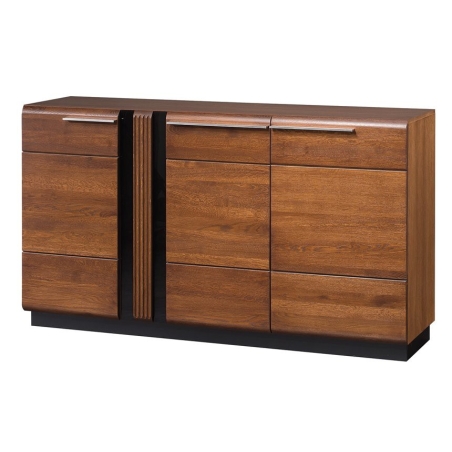
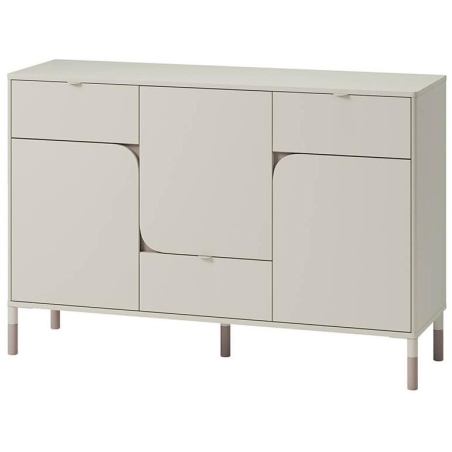
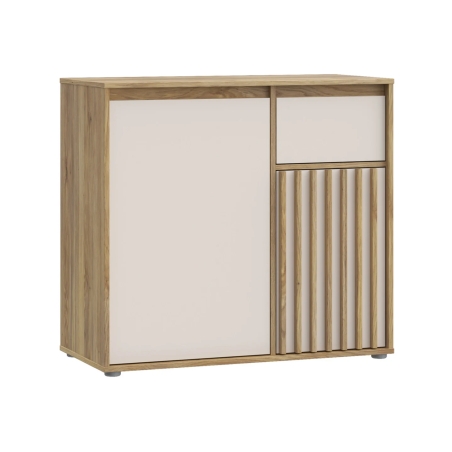
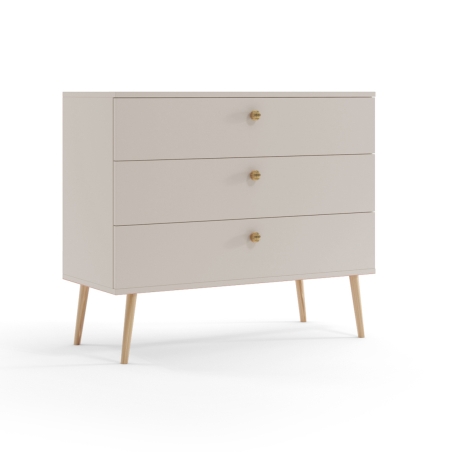
See what chests of drawers we have in our offer.
FAQ – Questions about furniture safety
Do I have to drill into the wall if I live in a rented apartment?
Safety is a priority. Most rental agreements allow minor drilling for expansion plugs, which can be easily filled before moving out. However, if you absolutely cannot drill, look for chests of drawers with a wide base and a low center of gravity, but remember – no solution without drilling guarantees 100% protection against tipping.
How many anchoring points should a wide chest of drawers have?
For chests of drawers up to 100 cm wide, one solid mounting point in the middle is sufficient. If the chest of drawers is wider or exceptionally tall, we recommend two mounting points placed symmetrically near both side edges of the furniture.
Are fabric straps as safe as metal angle brackets?
High-quality polypropylene straps have a breaking strength on the order of several hundred kilograms, which is fully sufficient. Their advantage is flexibility, which makes installation easier in places where the skirting board pushes the furniture away from the wall. Metal angle brackets are more rigid, which is desirable with very heavy furniture.